The meeting ends with a clear instruction, a firm deadline, and no questions. The leader leaves believing the team is aligned. A week later, the work tells a different story. One person has pursued speed,
another has protected accuracy, and a third has waited for approval that no one realized was necessary.
Everyone heard the same instruction. They did not leave with the same understanding of what it
required.
The familiar response is to communicate again: restate the message, simplify the language, distribute
the slide deck. Sometimes that is exactly what is needed. But repetition cannot resolve a difference that
has never been brought into the conversation. Nor can it reveal a concern that someone decided was
unsafe to express.
The problem may not be that the leader failed to speak clearly. The organization may have treated
speaking clearly as the whole task.
Communication Reframed begins with a different premise: leadership communication is both cognitive and affective. It involves the information people exchange and the emotional and relational conditions through which they interpret, question, and use that information. Accuracy matters. So does trust, dignity, attention, and the willingness to be influenced by what another person contributes.
Beyond the Message
Thinking of communication as transmission is useful when the task is to move information reliably. A time, location, safety warning, or operating instruction must reach the right person without distortion. Clarity, appropriate channels, and confirmation remain essential. Reframing communication does not make those responsibilities disappear. The problem arises when leaders use that same approach in every situation. A change initiative, a disagreement about priorities, or a conversation about performance is not simply a package of information waiting to be delivered. People bring different knowledge, interests, experiences, and concerns. Communication must make those differences available so people can adjust, coordinate, and act.
Consider the instruction to “take ownership.” One employee may hear permission to make decisions. Another may hear responsibility for outcomes without additional authority. A third may hear a warning that support will be withdrawn. The phrase is familiar, but its practical meaning is open to interpretation.
The leader could define the phrase more carefully. Better still, the conversation could establish which decisions employees can make, where consultation is required, what support is available, and how competing demands will be resolved. That exchange does more than clarify language. It creates a workable relationship between responsibility and authority. Understanding is necessary, but it is not the endpoint. People can understand a decision and still leave without knowing who will act, what support is available, or when a concern should be raised again. Communication becomes useful when it turns differing perspectives into responsibilities clear enough to guide coordinated action.
What CLEAR Reframes
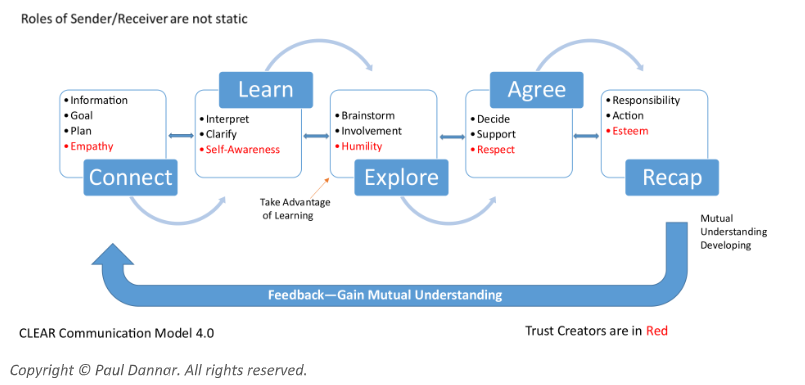
The CLEAR Communication Model provides a framework for holding those responsibilities together. Its value is not simply that it gives a conversation a structure. It asks leaders to reconsider what a conversation is supposed to accomplish. CLEAR stands for Connect, Learn, Explore, Agree, and Recap.
The framework links the work of establishing purpose, interpreting information, considering possibilities, making commitments, and following through with empathy, self-awareness, humility, respect, and esteem. These pairings are developed in the model’s theoretical treatment as a way to integrate the cognitive and affective dimensions of leadership communication.1
Figure 1. CLEAR Communication Model™ (Version 4.0)
CLEAR at a Glance
The cognitive phases pair with the affective Trust Creators shown in red in Figure 1.
Cognitive phase
Trust Creator (red in Figure 1)
Connect
Empathy
Learn
Self-Awareness
Explore
Humility
Agree
Respect
Recap
Esteem
The names are useful reminders, but the deeper contribution lies in what they ask us to notice. A conversation can be accurate yet dismissive, inclusive yet directionless, decisive yet poorly understood, or cordial yet unwilling to confront the issue that matters. Communication quality cannot be reduced to a single characteristic such as brevity, confidence, or warmth.
The model is also cyclical. New information may require people to revisit their understanding. An apparent agreement may reveal different expectations when responsibilities are discussed. A damaged relationship may need attention before further analysis becomes productive. Returning to an earlier concern is not necessarily a failure to progress. It may be what makes genuine progress possible.
Used this way, CLEAR is less a formula to follow than a discipline for examining the interaction. Are we learning anything that could change our understanding? Are people able to contribute honestly? Is the decision becoming actionable? What will this conversation make easier—or harder—the next time we need to work together?
There Are Two Responsibilities in Every Conversation
The cognitive responsibility concerns the substance of the work: facts, interpretations, alternatives, constraints, decisions, and commitments. It requires leaders to distinguish what is known from what is assumed, explain reasoning, and identify what remains unresolved.
The affective responsibility concerns how people experience the exchange: whether they feel heard, respected, threatened, dismissed, or recognized. “Affective” does not mean merely pleasant or emotional. It includes the attitudes and values that shape whether someone listens openly, raises a concern, or retreats into self-protection.
These responsibilities are intertwined. If a person expects humiliation for admitting uncertainty, the team may receive a confident answer instead of an accurate one. If challenging an assumption is treated as disloyalty, a leader may mistake silence for support. The relational conditions influence the quality of the information available for judgment.
The reverse matters too. Warmth cannot compensate for misleading information, unclear expectations, or an impossible commitment. A supportive conversation that leaves a person unsure what to do next has not fulfilled its purpose. Empathy and precision are complementary obligations, not competing styles of leadership.
Amy Edmondson’s research connects team psychological safety—the belief that interpersonal risks can be taken within the team—with learning behavior. A later meta-analysis examined the wider relationships between psychological safety, its antecedents, and work outcomes. 2 These findings support taking the social conditions of communication seriously. They do not mean that making people comfortable guarantees performance.
They also do not, by themselves, validate CLEAR as a complete intervention. The model’s theoretical manuscript proposes how its practices might support learning, well-being, and performance. Research on related concepts provides a foundation for those propositions, not proof that the full model produces every proposed outcome. 3
Values Become Visible in Behavior
Most leaders would endorse empathy, self-awareness, humility, respect, and recognition. The harder question is what those values require when the discussion becomes difficult.
Empathy requires attention to another person’s circumstances without automatically accepting their explanation. A leader can acknowledge that someone is overloaded while still addressing a missed commitment. The acknowledgment changes the quality of the inquiry; it does not erase accountability.
Self-awareness requires examining what the leader is bringing into the exchange. Frustration may be justified, but it can also narrow attention. A previous disappointment can turn a reasonable question into a perceived challenge. Before attributing resistance to the other person, the leader must consider whether their own expectations are shaping the interpretation.
Humility becomes visible when another person’s knowledge can alter the discussion. Asking for input after every meaningful decision has been closed is not the same as being open to influence. Where decisions are fixed, honesty about those limits is more respectful than offering participation that cannot affect anything.
Respect requires separating a person’s worth from the quality of a particular idea or result. An argument can be weak. A deadline can be missed. A proposed action can be unacceptable. Addressing these realities does not require diminishing the person involved.
Esteem goes beyond general praise. It recognizes a contribution specifically enough that the person knows what mattered. Thanking someone for identifying a risk—even when the warning complicates the plan—communicates that contribution is valued, not merely compliance.
These are not decorative additions to “real” communication. They shape which perspectives are heard, how disagreement is handled, and whether people will contribute candidly again.
The Cost of Apparent Agreement
One of the most consequential communication failures occurs when people leave a conversation using the same words to describe different commitments. “We will support the rollout” may mean providing staff to one manager, answering occasional questions to another, and endorsing the initiative publicly to a third. No one has necessarily been evasive. The agreement has simply remained too general to guide behavior. Leaders can address this by asking people to describe the implications in their own context. What will change in your work? What will you need from another group? Which competing responsibility may interfere? What would cause you to bring the issue back for discussion? These questions invite mutual clarification rather than a test of whether employees can repeat the leader’s words.
Agreement must also be distinguished from consent, compliance, and commitment. Someone may understand a decision without endorsing it. An employee may comply because it is required while remaining unconvinced by its rationale. Leaders should not demand an emotional performance of agreement as the price of professional participation.
Where a decision must be made without consensus, the responsibility is to explain it, acknowledge unresolved concerns, clarify expectations, and preserve an appropriate route for raising new evidence. Dialogue informs authority; it does not eliminate it.
Signs Your Team is Operating Under Apparent Agreement
Questions only happen after the meeting in side channels.
Deadlines are met, but work quality requires silent rework.
People describe different priorities or responsibilities after agreeing to the same plan.
Dependencies and resource gaps surface only when delivery is at risk.
No one can say who will raise a concern or when the agreement should be revisited.
Treat these signs as prompts for inquiry, not proof of disengagement. Ask what remains unclear, what people hesitate to raise, and which commitments need to become more specific.
A Different Kind of Performance Conversation
Imagine a supervisor meeting with an experienced analyst whose last three reports arrived late. The supervisor has already concluded that the analyst needs stronger time management. The analyst expects another conversation in which the deadline matters more than the conditions of the work.
Before — Assumed diagnosis
Supervisor: “You missed three deadlines. We need a plan to fix your time management.”
This states the problem but assumes its cause before the analyst can explain the work.
After — CLEAR inquiry
Supervisor: “These three reports arrived after the agreed date, which delayed the review. I want us to establish what needs to change. Walk me through what happens between receiving the data and submitting the report.”
The standard remains explicit, while the question opens the explanation to evidence.
The question does not excuse the delay. It makes room for information that a judgment about time management might conceal. Suppose the analyst explains that two source teams routinely submit incomplete data. The analyst has been repairing the gaps rather than escalating them, partly because earlier warnings were dismissed as excuses.
Now both parties have responsibilities to examine. The analyst’s decision to absorb the problem silently is not sustainable. The supervisor’s earlier responses may have discouraged timely reporting. The upstream process also requires attention. What began as a demand for better time management becomes a more accurate discussion of data quality, escalation, workload, and accountability. The resulting commitment might specify an earlier data cutoff, a named contact for unresolved gaps, and a requirement to flag risks before the reporting deadline. The analyst remains responsible for timely work and early escalation. The supervisor becomes responsible for addressing the dependency rather than merely repeating the deadline.
At the next review, they examine whether those changes worked. If they did not, the conversation reopens the explanation instead of assuming that a signed-off plan settled reality. Recognition can also be specific: an early warning that allowed the team to adjust should be acknowledged, even when it reported unwelcome news. This is communication doing leadership work. It produces a better account of the problem, a more credible commitment, and a relationship in which relevant information has a better chance of arriving in time.
Communication Leaves a History
No important conversation begins entirely from zero. People remember what happened when they last admitted an error, questioned a plan, or asked for support. Those experiences affect what they are prepared to say now. That history may not have been created by the leader conducting the conversation. It may have developed under previous supervisors, been reinforced by senior leaders, or become embedded in organizational practices. A leader can inherit distrust without having caused it, but still carries responsibility for how the next interaction adds to—or begins to change—that history.
A leader may sincerely invite candor today while employees remain cautious because candor carried a cost yesterday. Trust cannot be restored by announcing that the environment has changed. It requires observable responses over time: examining an unwelcome fact, correcting an unfair judgment, keeping a promise, and following up on a concern without punishing the person who raised it. This gives communication a cumulative quality. Each exchange addresses an immediate task while also teaching people something about how the organization works. Does expertise matter when it comes from someone junior? Are mistakes examined or hidden? Is respect maintained during disagreement? Do commitments survive the end of the meeting?
Formal values become credible—or lose credibility—in these ordinary interactions. An organization can publish a commitment to openness while its meetings teach silence. It can promote accountability while allowing leaders’ promises to disappear. Communication is one place where the distance between the stated culture and the experienced culture becomes visible.
Making the Reframe Practical
Applying CLEAR does not require turning every exchange into a lengthy facilitated discussion. The depth of the conversation should fit the stakes, uncertainty, and interdependence involved. A routine update may need concise information and a clear route for questions. A disputed change affecting several teams may require substantial dialogue before commitments are reliable.
Before an important conversation, a leader can identify its purpose and the limits of their current understanding. What must be decided? What is already fixed? Where could another person’s information change the approach? This preparation creates room for participation without promising influence the leader cannot offer. During the exchange, attend to both the substance and the conditions of participation. Seek evidence, clarify terms, and notice whether questions are being welcomed or closed down. Do not assume that silence reveals its own meaning; it may reflect agreement, uncertainty, caution, or a need for another way to respond. Before closing, make the practical implications explicit. People should know the decision, the responsibilities, the dependencies, and how new concerns will be handled. Follow-through then becomes part of communication, not a separate administrative afterthought. A conversation that produces commitments no one revisits teaches that the commitments were provisional, whatever the leader intended.
Leaders can assess progress through observable signs: risks raised earlier, fewer misunderstandings about responsibility, concerns brought into the room rather than circulated afterward, and more reliable follow-through. These signs are useful prompts for review, not a validated score of CLEAR effectiveness or evidence that communication alone caused an improvement.
Communication has limits. On its own, it cannot manufacture missing resources, remove every conflict of interest, or repair harmful incentives. Better dialogue may reveal that the organization must change a policy, allocate capacity, or make a difficult decision. The reframe matters precisely because it helps people see what action is required rather than treating every problem as a need for another message.
The Work of Communication
CLEAR asks leaders to take responsibility for more than what they intended to say. It directs attention to what people understood, what they were able to contribute, what they committed to do, and how the interaction affected their capacity to work together.
That responsibility is reciprocal. Employees, colleagues, and partners also have obligations to seek clarification, contribute relevant knowledge, surface constraints, and honor commitments. Leaders have a particular influence on whether those behaviors are encouraged, but coordinated action depends on participation from everyone involved.
Return to the meeting that ended with a clear instruction and no questions. The leader’s aim need not be a longer meeting or a more polished presentation. It should be a more useful exchange: one in which different interpretations can surface, concerns can be examined, and responsibilities can become specific enough to guide action.
The question is not only, “Was I clear?” It is also, “What did our conversation make possible?” Communication is reframed when the measure of success moves beyond delivery to the quality of response, relationship, and responsibility created between people. The message still matters. What people are able to coordinate and accomplish because of it matters more.
Put CLEAR to work in your team’s next important conversation. Use the five phases and their Trust Creators to assess what people understood, which concerns surfaced, and whether responsibilities became clear enough to guide action. Choose one change to test, then revisit it with the team. Share what you learn with Leading Reframed at editor@leadingreframed.com—especially where apparent agreement gave way to a more useful exchange.
Notes
Paul Dannar, “CLEAR Communication as an Affective-Domain Pathway to Positive Psychology at Work: An Integrated Theoretical Article and Research Agenda” (unpublished manuscript, February 2026).
Amy Edmondson, “Psychological Safety and Learning Behavior in Work Teams,” Administrative Science Quarterly 44, no. 2 (1999): 350–383, https://doi.org/10.2307/2666999; M. Lance Frazier et al., “Psychological Safety: A Meta-Analytic Review and Extension,” Personnel Psychology 70, no. 1 (2017): 113–165 https://doi.org/10.1111/peps.12183.
Dannar, “CLEAR Communication.”
Join the Conversation.
One Response
Same words, different commitments” is the line that stuck with me. In my work with leaders navigating disruption, I see this gap widen exactly when the stakes are highest. Under change, people don’t only interpret the words differently. They respond differently too. One person runs ahead, another waits for permission, another quietly protects what’s working. Everyone “agreed,” and everyone is acting in good faith, but they’re moving in different directions.
That’s why the questions you suggest matter so much: “What will change in your work? What would cause you to bring this back?” They test an agreement before reality does.
The point about communication leaving a history also deserves more attention. A leader can announce that the door is open, but people decide whether to walk through it based on what happened the last time someone did.
“What did our conversation make possible?” is a better test than “Was I clear?” I’ll be borrowing it.
ABC Manufacturing is a mid sized company that produces industrial equipment for commercial clients. The organization recently adopted a faster product development cycle to stay competitive. This shift has increased pressure on cross-departmental teams, especially Operations, Marketing, and Data Analytics, whose work must align precisely to keep projects on schedule.
Good coaching depends on more than asking thoughtful questions. It requires a conversation in
which both people understand what is being explored, why it matters, and what should happen
next. The CLEAR Communication Model offers coaches and leaders a practical way to create
that understanding.
Baseball appears to pause between pitches. In reality, those pauses are filled with
communication.
The catcher lowers a hand between their knees. The pitcher nods, shakes their head, or steps off
the rubber. An infielder moves two steps toward second base. A coach touches an arm. A runner
extends a lead. The umpire settles into position behind the plate.
No words have been exchanged, yet nearly everyone has communicated something.
Baseball is often described through its visible actions: the pitch, the swing, the catch, the throw, and
the run. Underneath those actions is an extensive communication system connecting players,
coaches, umpires, fans, and even opponents. Some messages are intentionally sent. Others are
conveyed through posture, timing, movement, and reaction. Some must be understood immediately.
Others are deliberately concealed.
A baseball game is a conversation conducted largely without sentences.






One Response
Same words, different commitments” is the line that stuck with me. In my work with leaders navigating disruption, I see this gap widen exactly when the stakes are highest. Under change, people don’t only interpret the words differently. They respond differently too. One person runs ahead, another waits for permission, another quietly protects what’s working. Everyone “agreed,” and everyone is acting in good faith, but they’re moving in different directions.
That’s why the questions you suggest matter so much: “What will change in your work? What would cause you to bring this back?” They test an agreement before reality does.
The point about communication leaving a history also deserves more attention. A leader can announce that the door is open, but people decide whether to walk through it based on what happened the last time someone did.
“What did our conversation make possible?” is a better test than “Was I clear?” I’ll be borrowing it.